








 |
|---|
| This article is part of a series on the politics and government of India |
 India portal India portal |
This is a list of the heads of state of India, from the independence of India in 1947 to the present day. The current head of state of India is Ram Nath Kovind, elected in 2017 after being nominated by BJP, the party run by Prime Minister Narendra Modi.
From 1947 to 1950 the head of state under the Indian Independence Act 1947 was King of India,[1][2] who was also the monarch of the United Kingdom and of the other Dominions of the British Commonwealth. The monarch was represented in India by a governor-general. India became a republic under the Constitution of 1950 and the monarch and governor-general were replaced by a ceremonial president.
Monarch (1947–1950)[edit | edit source]
The succession to the throne was the same as the succession to the British throne.
| № | Monarch (Birth–Death) |
Portrait | Reign | Royal House | Prime Minister | Governor General | |
|---|---|---|---|---|---|---|---|
| Reign start | Reign end | ||||||
| 1 | George VI (1895–1952) |

|
15 August 1947 | 26 January 1950 | Windsor | Nehru | Mountbatten (1947–1948) |
| Rajagopalachari (1948–1950) | |||||||
Governor-General[edit | edit source]
The Governor-General was the representative of the Monarch in India and exercised most of the powers of the Monarch. The Governor-General was appointed for an indefinite term, serving at the pleasure of the Monarch. After the passage of the Statute of Westminster 1931, the Governor-General was appointed solely on the advice of the Cabinet of India without the involvement of the British government. In the event of a vacancy the Chief Justice served as Officer Administering the Government.
| № | Governor-General (Birth–Death) |
Portrait | Tenure | Monarch | Prime Minister | |
|---|---|---|---|---|---|---|
| Took office | Left office | |||||
| 1 | The Rt. Hon. The Earl Mountbatten of Burma (1900–1979) |

|
15 August 1947 | 21 June 1948 | George VI | Nehru |
| 2 | Chakravarti Rajagopalachari (1878–1972) |

|
21 June 1948 | 26 January 1950 | ||
President of India[edit | edit source]
Under the Constitution, of the Republic of India, the president replaced the monarch as ceremonial head of state. The president is elected by the Electoral College for a five-year term. In the event of a vacancy, the vice president serves as acting president.
- Status
| № | President (Birth–Death) |
Portrait | Tenure | Elected | Political affiliation (at time of appointment) |
Prime Minister | ||
|---|---|---|---|---|---|---|---|---|
| Took office | Left office | |||||||
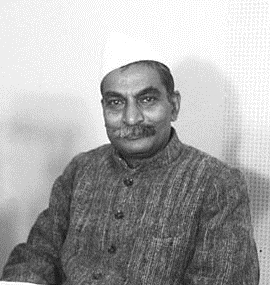
| 1 | Rajendra Prasad (1884–1963) |

|
26 January 1950 | 13 May 1962 | 1952 1957 |
Indian National Congress | Nehru | |
| 2 | Sir Sarvepalli Radhakrishnan (1888–1975) |

|
13 May 1962 | 13 May 1967 | 1962 | Independent | Nehru Nanda Shastri Nanda Gandhi | |
| 3 | Zakir Husain (1897–1969) |

|
13 May 1967 | 3 May 1969 (died in office.) |
1967 | Independent | Gandhi | |
| – | V. V. Giri (1894–1980) |

|
3 May 1969 | 20 July 1969 | – | Independent | Gandhi | |
| – | Mohammad Hidayatullah (1905–1992) |

|
20 July 1969 | 24 August 1969 | – | [3] | Gandhi | |
| 4 | V. V. Giri (1894–1980) |
|
24 August 1969 | 24 August 1974 | 1969 | Independent | Gandhi | |
| 5 | Fakhruddin Ali Ahmed (1905–1977) |
|
24 August 1974 | 11 February 1977 (died in office.) |
1974 | Indian National Congress | Gandhi | |
| – | B. D. Jatti (1912–2002) |
|
11 February 1977 | 25 July 1977 | – | Indian National Congress | Gandhi Desai | |
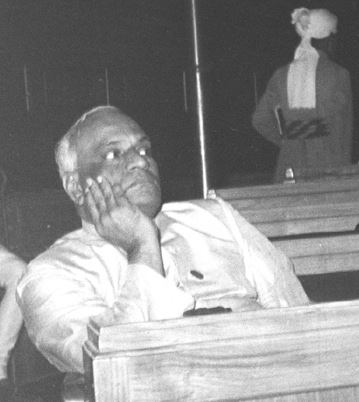
| 6 | Neelam Sanjiva Reddy (1913–1996) |

|
25 July 1977 | 25 July 1982 | 1977 | Janata Party | Desai Singh Gandhi | |
| 7 | Giani Zail Singh (1916–1994) |
.png)
|
25 July 1982 | 25 July 1987 | 1982 | Indian National Congress | Gandhi Gandhi | |
| 8 | R. Venkataraman (1910–2009) |

|
25 July 1987 | 25 July 1992 | 1987 | Indian National Congress | Gandhi Singh Shekhar Rao | |
| 9 | Shankar Dayal Sharma (1918–1999) |

|
25 July 1992 | 25 July 1997 | 1992 | Indian National Congress | Rao Vajpayee Deve Gowda Gujral | |
| 10 | K. R. Narayanan (1920–2005) |

|
25 July 1997 | 25 July 2002 | 1997 | Indian National Congress | Gujral Vajpayee | |
| 11 | A. P. J. Abdul Kalam (1931–2015) |

|
25 July 2002 | 25 July 2007 | 2002 | Independent | Vajpayee Singh | |
| 12 | Pratibha Patil (born 1934) |

|
25 July 2007 | 25 July 2012 | 2007 | Indian National Congress | Singh | |
| 13 | Pranab Mukherjee (1935–2020) |

|
25 July 2012 | 25 July 2017 | 2012 | Indian National Congress | Singh Modi | |
| 14 | Ram Nath Kovind (born 1945) |

|
25 July 2017 | Incumbent | 2017 | Bharatiya Janata Party | Modi | |
Standards[edit | edit source]
-
 Badge of Monarch of India (1947–1950)
 -
Governor-General's Standard (1947–1950)
-
 Presidential Standard (1950–1971)
.png)
.svg)
.svg)
Living former heads of state[edit | edit source]
There is only one living former Indian head of state:
| Image | Name | Term/reign | Office | Date of birth |
|---|---|---|---|---|
|
|
Pratibha Patil | 2007–2012 | President of India | 19 December 1934 |
References[edit | edit source]
- ↑ The Contemporary Commonwealth: An Assessment 1965-2009, Taylor & Francis, 2009, p. 22, ISBN 9781135238308,
On independence in 1947, George VI became 'King of India' until the adoption of republican status in 1950.
- ↑ Jawaharlal Nehru (1991), Selected Works of Jawaharlal Nehru: 21 June to 15 August 1949, Jawaharlal Nehru Memorial Fund, p. 363,
King George was in effect King of India and it was as such that he functioned as the Head of the Indian State. He did not function in India as the King of England.
- ↑ Was Chief Justice of India